Memecoins: The Complete Degen Guide
What memecoins actually are, how they got here, how we trade them, why the President launched one on Solana, and the exact stack we use to buy in without getting rugged.
The one-line version
A memecoin is a token whose value comes from culture, not cash flow. There is no business behind it. There is a joke, a mascot, a community, and a chart. That is the entire product, and for the last three years it has been the single most profitable, most brutal corner of crypto.
A short backstory, so the rest makes sense
Memecoins started as a joke in 2013 when a software engineer named Billy Markus forked Litecoin, slapped the Doge Shiba Inu on it, and shipped Dogecoin in a weekend. Nobody took it seriously. That was the point.
Then a few things happened, in order:
- 2020 to 2021: Elon Musk tweeted Doge into a 100x. The crowd realised memes were an asset class, not a punchline.
- 2021: Shiba Inu launched on Ethereum and did another 1000x. The template was set. Deploy a token with an animal, seed some liquidity, let the community do the marketing.
- 2023: Solana came back from the FTX crater with cheap fees and a fast chain. Memecoins migrated en masse. BONK printed, then WIF, then a thousand imitators.
- 2024: Pump.fun launched. Anyone with a wallet could deploy a token in ten seconds for a dollar. The floodgates opened. On peak days Pump.fun ships more than 30,000 new tokens in 24 hours.
- 2025: The TRUMP token launches on Solana three days before the US presidential inauguration. It hits a fully diluted valuation of over $70 billion within 48 hours. The line between memes and politics is officially dead.
We traded through all of it. This guide is the version of the playbook we wish someone had handed us in 2023.
Why people actually buy them
Nobody buying WIF thinks it will replace the dollar. The trade is simpler than that.
- Asymmetric upside. A $10k position in a token that goes from a $2M market cap to $200M returns a million. Very few asset classes offer that shape of risk.
- Cultural leverage. A meme that lands is a marketing budget that runs itself. Once the crowd owns it, they promote it for free.
- Speed. A memecoin cycle used to take months. On Solana today it can take hours. You can be in a full cycle before your bank has processed a wire.
The trade-off is that most of them go to zero. Not 80 percent. Not 90 percent. Roughly 99 percent of tokens deployed on Pump.fun never leave their bonding curve. The 1 percent that do is where the money is, and the whole game is filtering for that 1 percent before the rest of the market notices.
The night the President launched a coin
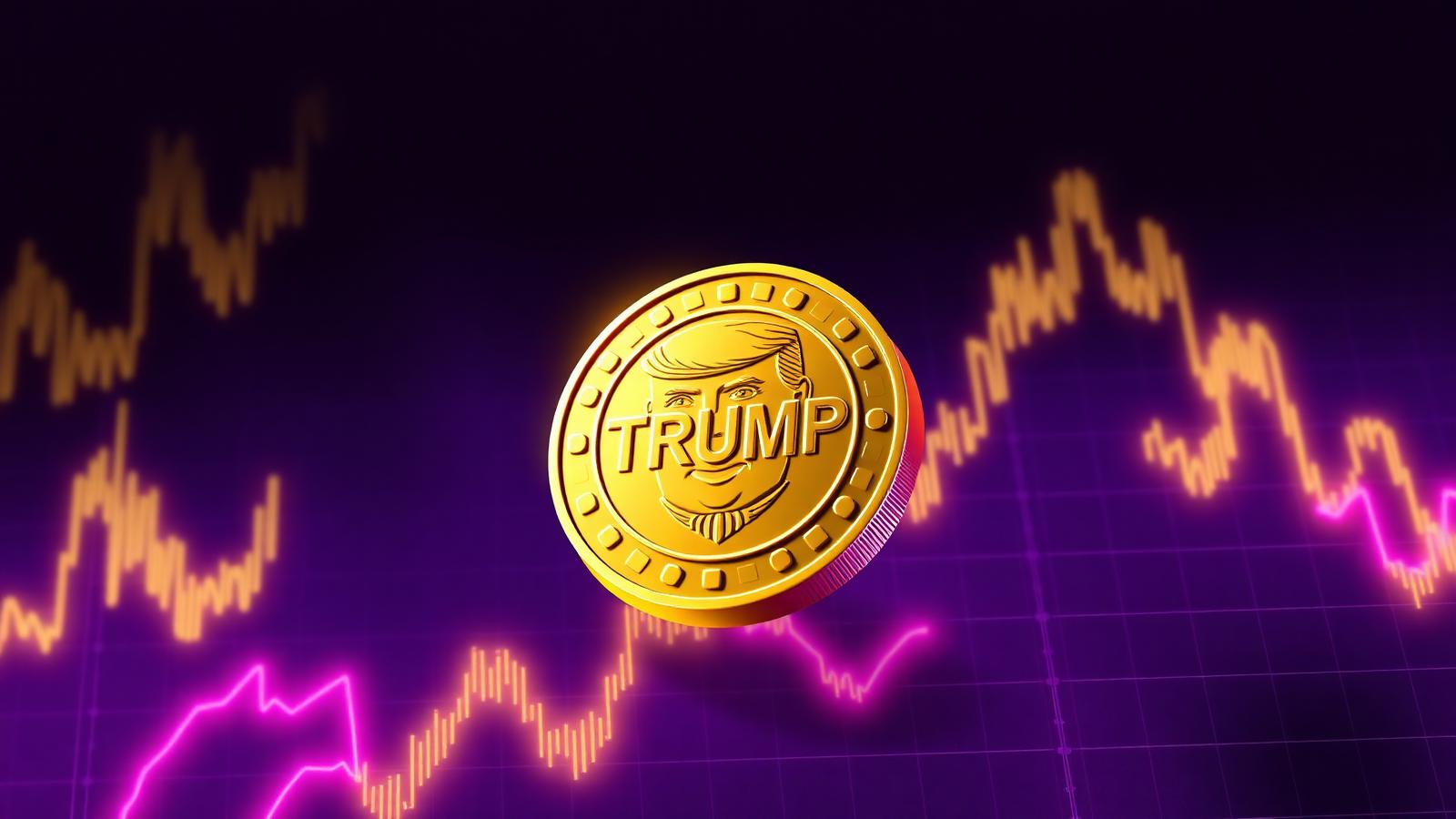
On January 17, 2025, Donald Trump posted "My NEW Official Trump Meme is HERE" on Truth Social and X, with a Solana contract address. Within an hour the token was trading. Within six hours it was the most-searched crypto on Google worldwide. Within 48 hours TRUMP had a fully diluted valuation north of $70 billion, briefly making it a top-15 crypto asset globally.
Two days later, MELANIA launched from the First Lady's official accounts and did roughly the same run in reverse, cratering as fast as it rose. The pattern was textbook memecoin: parabolic pump, rotational blow-off, and a long slow bleed as insiders unlocked.
Whatever you think of the politics, three things are worth taking from that week:
- Memecoins are mainstream distribution now. The sitting US President chose Solana as his launch venue. That is not a niche any more.
- Insider allocation is the single most important number. Roughly 80 percent of TRUMP's supply was held by entities linked to the launch team, on short unlock schedules. Everyone who ignored that number and bought the top learned about token economics the hard way.
- Solana is the memecoin chain. Ethereum has more capital. Solana has more shots on goal. In 2026 it is not close.
What is Pump.fun, and how do you actually launch a coin
Pump.fun is the launchpad that turned memecoin creation from a weekend engineering project into a 30-second click-through. It runs on Solana, and it is the single reason 2024 and 2025 shipped more tokens than the entire prior history of crypto combined.
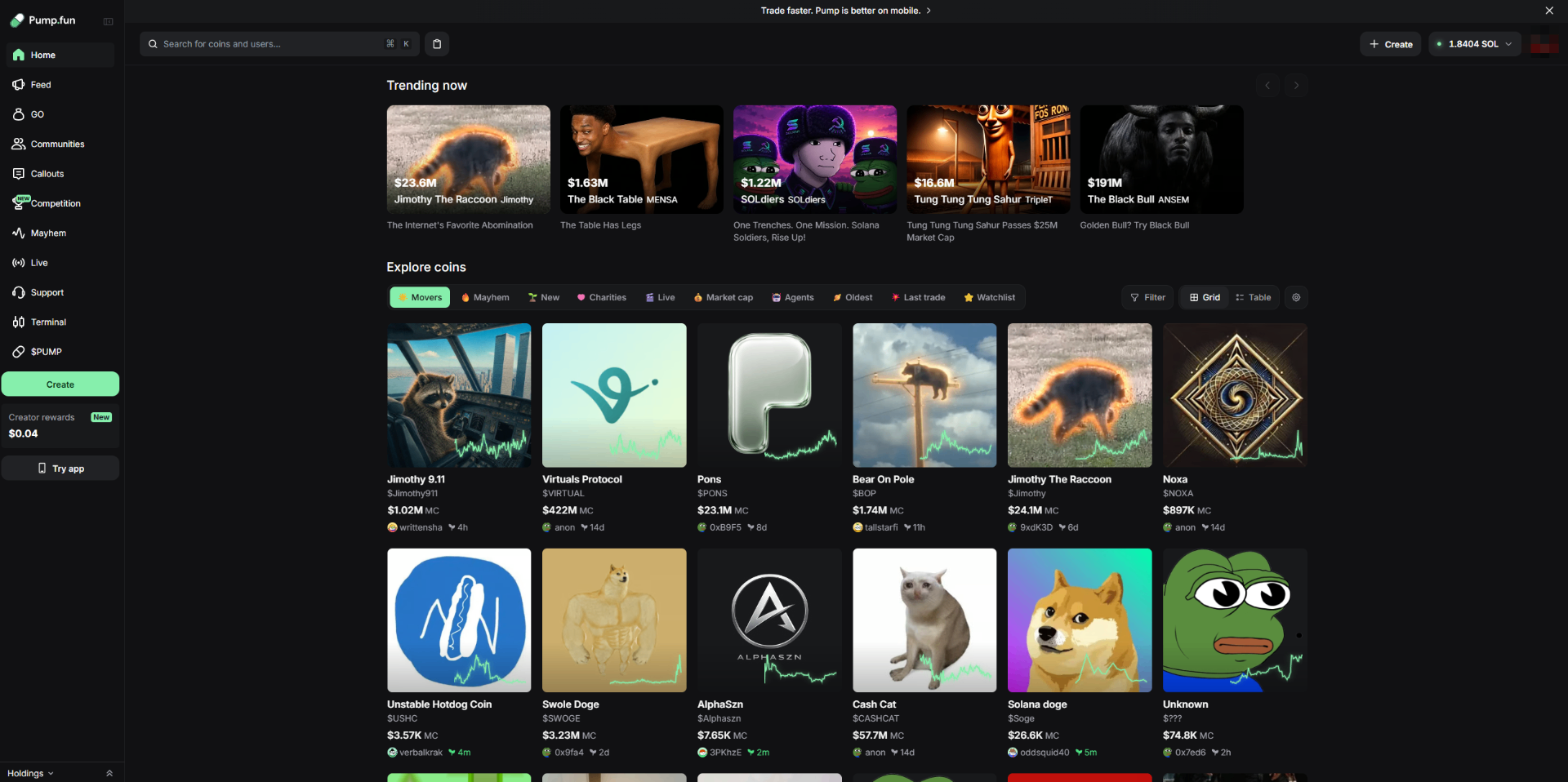
The mechanic that made it work is the bonding curve. Instead of the creator seeding a liquidity pool with their own SOL (the old way, which required capital and trust), Pump.fun deploys every token onto a mathematical curve where price rises automatically as people buy in. Once a token's market cap hits roughly $69k of buy pressure, it "graduates": Pump.fun migrates the liquidity to a real Solana AMM (Raydium or its own PumpSwap), burns the LP tokens, and the coin trades like any other Solana asset. Before graduation, the creator cannot rug the liquidity because there is no liquidity to pull. That single design decision is what let normies mint coins without instantly nuking their buyers.
Direct link: pump.fun.
Launching a coin in 30 seconds
The UI is deliberately dumb-simple. Here is the entire flow:
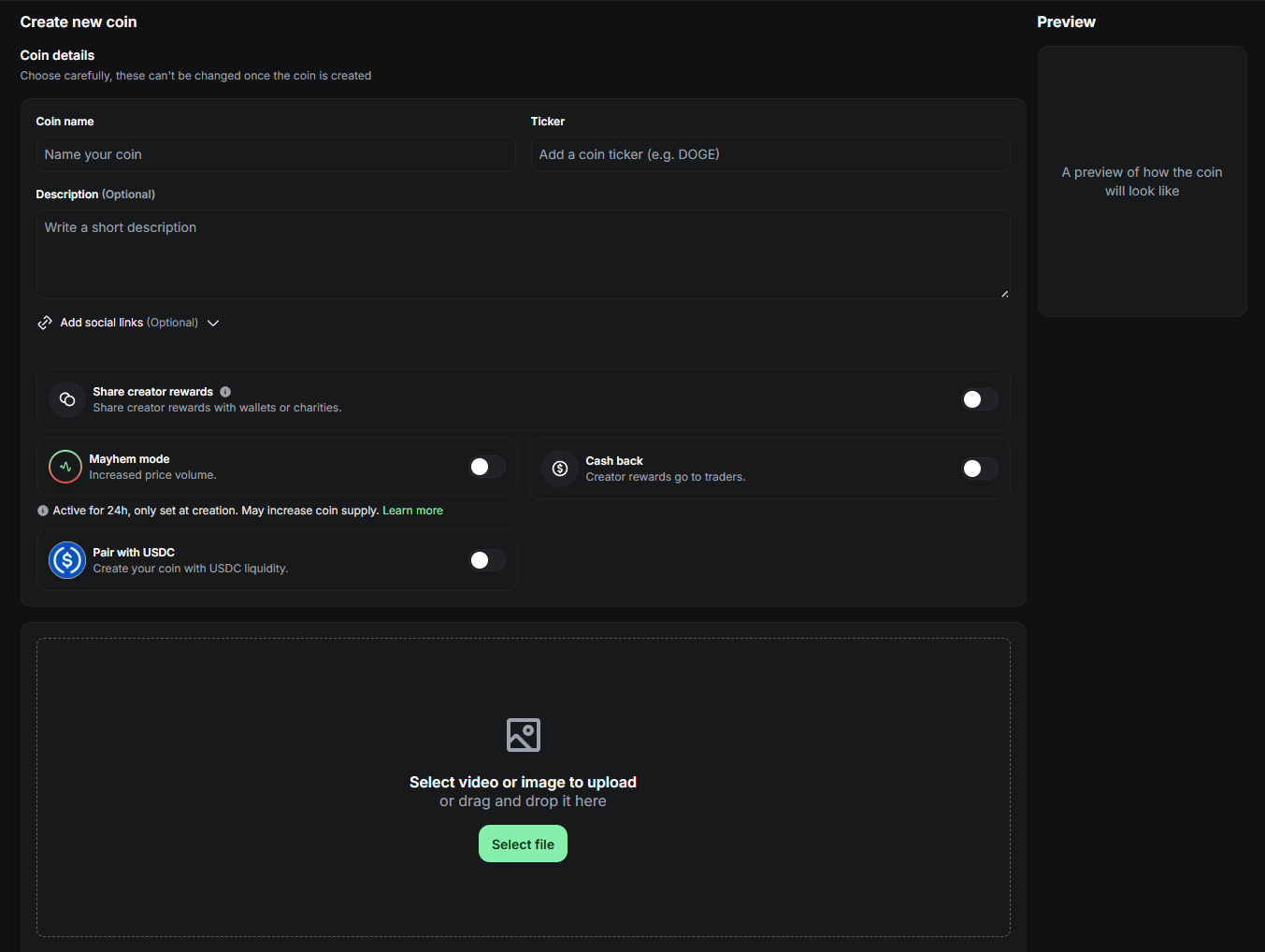
- Connect a Solana wallet (Phantom or Backpack). You need roughly 0.02 SOL to cover the deploy fee and a tiny first buy.
- Click Create in the top right, then fill three fields: coin name, ticker, one-line description.
- Upload an image or short video. This is the whole marketing asset. Square PNG works best because it renders cleanly in every downstream tool (DexScreener, Axiom, Telegram previews).
- Optional: add socials (X handle, Telegram, website). Coins with zero socials look like rugs to buyers and rarely trend, so add at least one.
- Optional toggles. "Share creator rewards" splits your fee stream with another wallet or a charity. "Mayhem mode" boosts volume for 24h but may inflate supply, "Pair with USDC" launches against USDC instead of SOL. Leave all of these off for a standard launch.
- Click Create Coin, approve the transaction, done. Your token is live, tradable, and on the Pump.fun feed within seconds.
That is it. No contract to write, no liquidity to seed, no Raydium pool to configure. The whole flow costs roughly $2 to $3 in SOL fees.
If you actually want it to go anywhere
Deploying is the easy part. Getting past the bonding curve is where 99 percent of coins die. Real distribution looks like: a genuine meme (not a generic dog), a tight Telegram or X community pre-launch, a first buy from the creator in the low hundreds of dollars to set a floor, and coordinated posting the moment the coin goes live so the first ten minutes of the chart show real volume rather than a flatline. Without those, the token sits at a $4k market cap forever.
Pump.fun is a distribution machine, not a printer. Treat it like the platform it is: cheap to try, brutal to actually win on.
Here is our real workflow, stripped of the LinkedIn talk.
1. Where the shots come from
We do not scroll Pump.fun. That is a firehose of pure noise. We watch three sources instead:
- DexScreener trending for tokens with real, sustained volume across multiple timeframes. Anything trending on the 6h and 24h tab, not just the 5m tab, is where the crowd is actually sitting. Our own Solana memecoin trending mirrors this, filtered for scam-shape flow.
- On-chain wallet tracking on 20 to 30 wallets we know made money in the last cycle. When four of them buy the same ticker in the same hour, that is signal.
- Culture. If a meme is spreading on Crypto Twitter or in the big Telegram groups before it has a token attached, that is the ideal entry. By the time you see it on DexScreener trending you are already late.
2. What we filter out immediately
Before any buy, we open the DexScreener page and check three things. If any of them fails, we walk.
- Liquidity below $50k. Below that number, we cannot exit without moving the price ten percent against ourselves.
- Top 10 holders own more than 25 percent. That is a dump waiting to happen.
- Mint or freeze authority not revoked. The dev can mint more supply or freeze your wallet. Instant no.
We also glance at the buy/sell ratio. Fully one-sided flow (pure buys, no sells) usually means a bot is faking volume. A healthy chart shows 40 to 60 percent buys over 24 hours.
3. Position sizing
The single most important rule, and the one that took us the longest to learn: size for zero.
Every memecoin position is one that can go to zero the next hour. Sizing rules that survive that:
- Never more than 2 percent of the total book on one memecoin.
- Take initial cost off at 2x. That way the remainder is house money and you can hold for the actual move without a heart rate.
- Set a mental stop at minus 40 percent. If you find yourself explaining why this time is different, you are already down 60.
4. The exit is the whole game
The pump is easy. The exit is where 90 percent of the P and L is decided. We ladder sells: 25 percent at 3x, 25 percent at 5x, 25 percent at 10x, hold the last 25 for the tail. This gets you the fat move without holding a bag for six months waiting for the top you missed.
The tool we actually use: Axiom
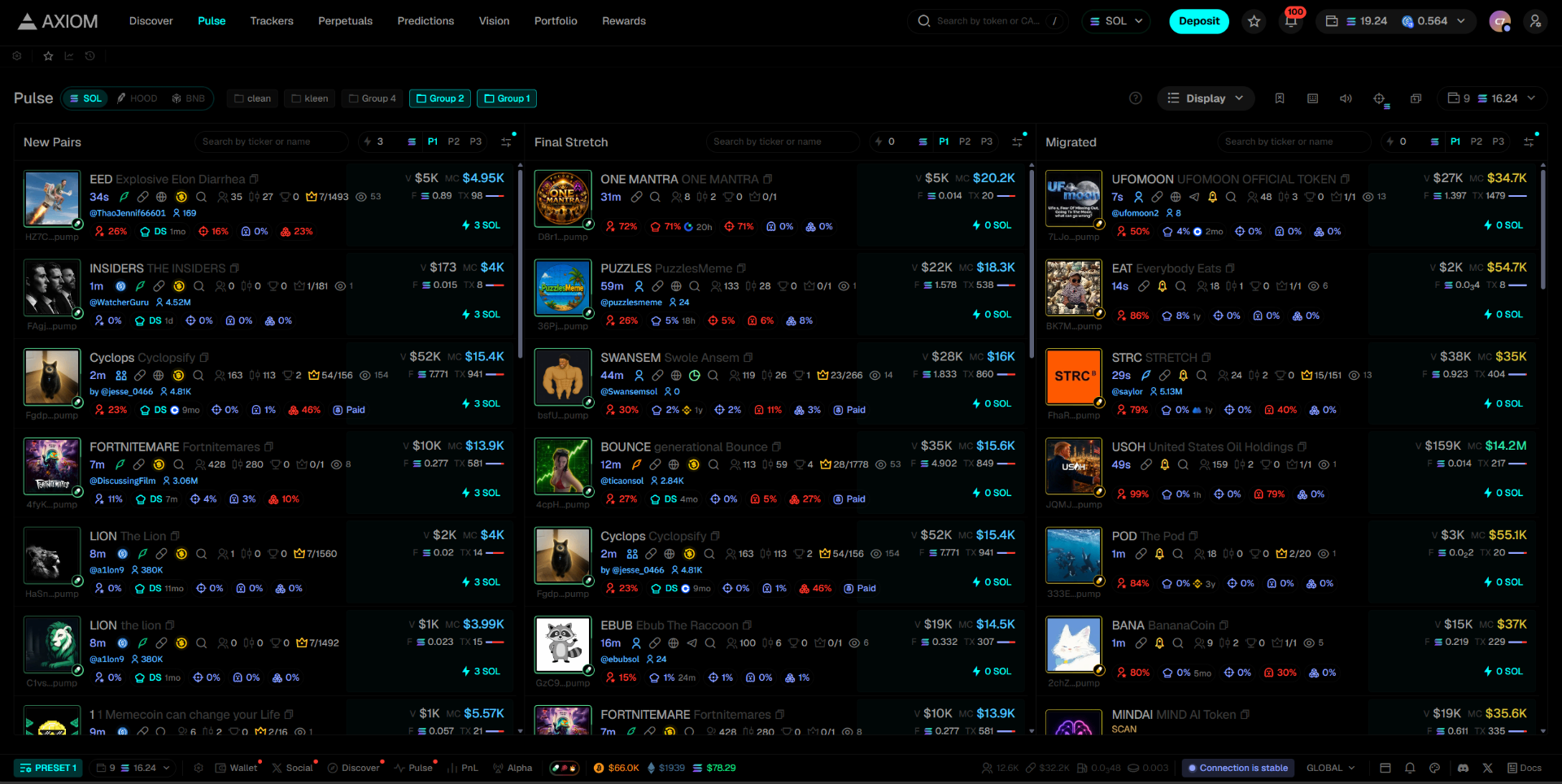
There are a dozen Solana trading bots. We have tested all the ones with meaningful volume. Our current pick, and the one we run our own money through, is Axiom. Direct link: axiom.trade/@ce0.
Reasons, briefly:
- Web-based, connects to your own wallet. Not custodial. Your keys stay with Phantom or Backpack. This matters more than anything else on this list.
- Real limit orders and stop losses on Solana. Most bots only do market orders. Axiom actually cancels and resubmits under the hood so you get real conditional execution.
- Copy trading that works. You paste a wallet, set a max size per trade, and it mirrors positions with a lag of a few hundred milliseconds. Combined with wallet tracking, this is the single fastest way to compound in a memecoin cycle.
- Fees are competitive. 0.7% on swaps at time of writing, cheaper than Photon on some routes, in line with GMGN.
If you want to try it, our referral link is axiom.trade/@ce0. Signing up through it costs you nothing and knocks a small amount off your fee tier. Full ranking of every bot we tested lives on our Trading Bots page.
How to actually buy Solana in the first place
If you are new to this and reading with a bank account and no wallet, here is the shortest path from zero to trading a memecoin.
Step 1: Buy SOL on a reputable exchange
For most people the answer is Kraken or Coinbase. Both accept normal fiat rails (bank transfer, Interac in Canada, ACH in the US, SEPA in EU). Fees are reasonable if you use their pro / advanced interfaces rather than the beginner "simple buy" flow, which quietly charges you north of 1 percent.
- Sign up, verify ID, deposit fiat.
- Buy SOL. That is the ticker.
- Do not leave it on the exchange. Every trade you make on Solana needs SOL in your own wallet.
Full comparison of exchanges lives on our Exchanges page.
Step 2: Set up a Solana wallet
Two we trust:
- Phantom (browser extension and mobile app). The default. Clean UX, hardware wallet support, has never had a serious incident.
- Backpack. Younger, faster, better UX for power users.
Write down the 12-word seed phrase on paper. Not a screenshot. Not iCloud. Paper. This is the one step where cutting a corner will actually cost you everything.
Step 3: Withdraw SOL from the exchange to your wallet
In your wallet, copy your Solana address. On the exchange, choose Withdraw, paste the address, pick the Solana network (not Ethereum, not anything else), send. It arrives in under a minute for a fraction of a cent.
Step 4: Connect to a trading interface
Open Axiom (or Jupiter if you want to swap manually with no bot layer). Click connect wallet. Approve. You can now trade any token that has a liquidity pool on Solana.
That is the whole path. From fiat to your first memecoin trade is realistically an hour of setup on day one and 30 seconds per trade after that.
Risks we do not sugarcoat
- Rugs. The dev pulls liquidity and vanishes. Non-negotiable filter: revoked mint and freeze authority, no whale concentration.
- Honeypots. The contract lets you buy but blocks selling. DexScreener flags most of these. If sell tax is above 10 percent, walk.
- Sandwich MEV. Big buys on illiquid pairs get front-run. Set slippage manually. Never use "auto" on a thin pool.
- You. Speed is the whole edge and the whole trap. The rails that let you cash out in ten seconds let you re-enter in five. Session limits and a hard weekly loss cap are not optional. They are the only reason we are still trading three years in.
Bottom line
Memecoins are the most efficient distribution mechanism crypto has ever produced. That is a real thing, not a joke, even if the assets themselves are jokes. In 2026 the entire cycle - narrative, launch, pump, distribution, top - can complete inside 48 hours, and Solana is where almost all of it happens.
If you are going to play, play seriously. Use a non-custodial bot (we use Axiom). Filter for real liquidity before you touch a buy button. Size every position for zero. Ladder your exits. And treat the whole book as an experiment: never more than you would happily set on fire for the story.
The upside is real. So is the zero. Both are the whole point.